Quick Answer
Start your seating chart when RSVPs come in, about 6 weeks out. Count your tables, seat the head table and family first, then group everyone else by who they know. Type the final list as plain lines in a Google Doc or Word document, in the exact order you want on the sign, and send it about 4 weeks out.
A seating chart is two jobs that people tend to blur together. The first is deciding who sits where, on paper, a floor plan or a spreadsheet. The second is the sign guests read at cocktail hour, which is made from the final list. Get the first one tidy and the second takes care of itself.
When should you start your wedding seating chart?
Rough it out once most RSVPs are in, and finish it in the two weeks after your RSVP deadline. We'd recommend an RSVP deadline about 6 weeks before the wedding, which leaves two weeks to chase the last replies and settle the tables before your list is due about 4 weeks out.
Starting earlier than that mostly means doing it twice. A draft from your invite list is useful for counting tables with your venue, but names will move once replies arrive.
You don't need the list to order the sign. Of the 168 seating charts ordered from us between late October 2025 and late October 2026 whose couples answered "Is your list ready?", 117 said no, about 7 in 10. Couples without a list ordered a median of about 10 weeks before the wedding; couples who already had theirs ordered a median of about 4 weeks out.
How many tables do you need for your guest count?
Divide your guest count by the seats per table and round up. A 60-inch round seats 8 and a 72-inch round up to 10; ask your venue which they have and how many fit the room.
| Guests | Tables of 8 | Tables of 10 |
|---|---|---|
| 50 | 7 | 5 |
| 80 | 10 | 8 |
| 100 | 13 | 10 |
| 120 | 15 | 12 |
| 150 | 19 | 15 |
| 200 | 25 | 20 |
| 250 | 32 | 25 |
| 300 | 38 | 30 |
Count the head table separately, and leave one or two open seats spread across the room. That slack is what makes late changes easy.
Your table count is also the size of your table number set. Ours come in sets of 1 to 40, in the same four collections as the charts, and you can ask for table names instead of numbers.
For a sense of scale: of the 121 seating charts ordered from us in that same year that carried a guest count, the middle guest-count tier was 141–150, half fell between about 110 and 180 guests, and they ranged from fewer than 50 to nearly 300. Of 151 table number sets ordered in the same year, the median was 14 tables, and half were between 10 and 18.

How do you decide who sits where?
Work from the front of the room outward, then fill in by friend group.
- Seat yourselves first. A head table puts you with your wedding party along one long table facing the room. A sweetheart table seats just the two of you, with the wedding party and their partners at tables nearby.
- Seat immediate family next, at the tables closest to you. Parents usually host their own tables with siblings, grandparents and close family friends. If parents are divorced, give each their own table at an equal distance.
- Group everyone else by how they know you: college friends, work friends, a parent's friends, cousins. Each guest should know at least two people at their table.
- Place guests with needs before the rest. Older relatives sit away from the speakers and near a clear path to the door and restrooms. Guests in wheelchairs need a table edge with room to pull in.
- Fill the gaps last, with guests who'll get along with any table.
Plus-ones sit with their date, always. Kids under about 8 sit with their parents; a kids' table works when there are six or more children of similar age, placed near their parents' tables. Single guests go with the friends they know best. Skip a singles table: it singles people out, and guests notice.
The wedding party at a head table still goes on the chart, with "Head Table" in place of a number. A couple at a sweetheart table doesn't need to be listed at all.
Copy our wedding seating chart template
Plan the tables however you like, but send the final list as plain lines, typed in the exact order you want on the sign. We copy your list straight into the design, so plain lines keep every name exactly as you typed it. Spreadsheet grids get in the way, and any extra numbering, punctuation or spacing you add will appear on the sign.
Download our seating chart guide to submit (a Word document that also opens in Google Docs). It has three layouts; keep the one you want and delete the other two. Alphabetical by last name looks like this:
A
Adams Grace 7
Alvarez Daniel 2
B
Bennett Olivia 7
Brooks Henry 2
- Alphabetical by last name: a letter heading, then each guest as last name, first name and table number.
- Alphabetical by first name: the same, with the first name first: "Anna Smith 7" under A.
- By table number: the table number on its own line, then the names seated there. This reads best at about 8 tables or fewer.
- The table: a number, "Head Table", or your table name if you're using names instead of numbers. It must match the table signs exactly.
Count the names per table as a final check: no table should have more names than seats.

Rather not sort it by hand? Paste your list into our free seating chart planner and it sorts every name A–Z or by table, counts your guests and tables, and downloads the list in the format we use.
How should the names be laid out on the sign?
Alphabetically by last name, with the table number beside each name, for most weddings; listing by table only reads quickly at about 8 tables or fewer. We cover couples, families, plus-ones and the heading in Seating Chart: Alphabetical or by Table?
The size follows the guest count: a 24x30 chart holds up to about 170 guests, and larger lists move to a 24x36 or 24x47 chart or a long linen chart. Above 24 tables or about 200 guests, or from about 150 when everyone arrives at once, we'd recommend a two-panel double seating chart so two groups can read at the same time. How Big Should a Wedding Seating Chart Be? has the full table, or enter your count in our seating chart size calculator.

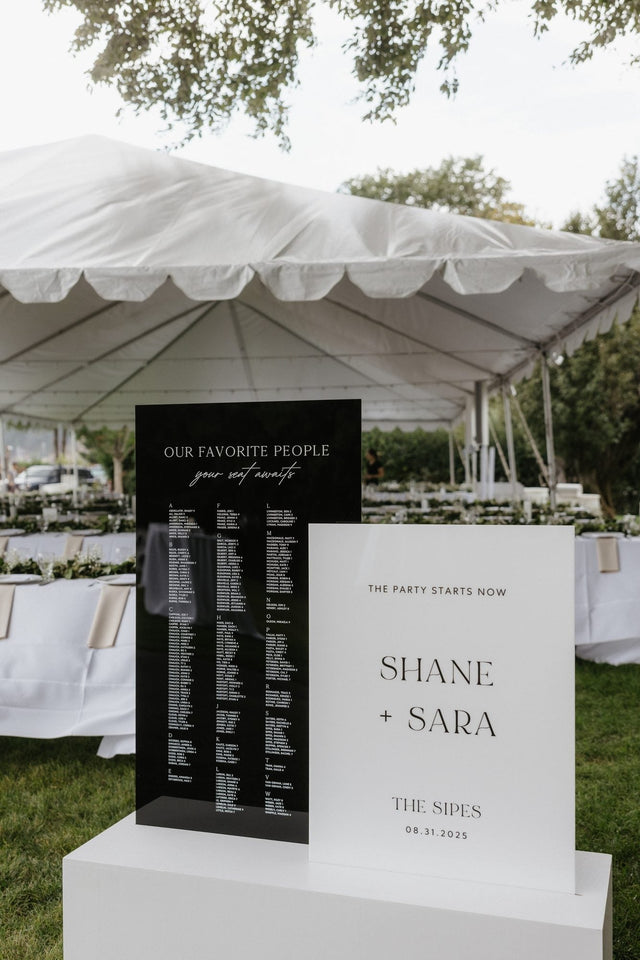
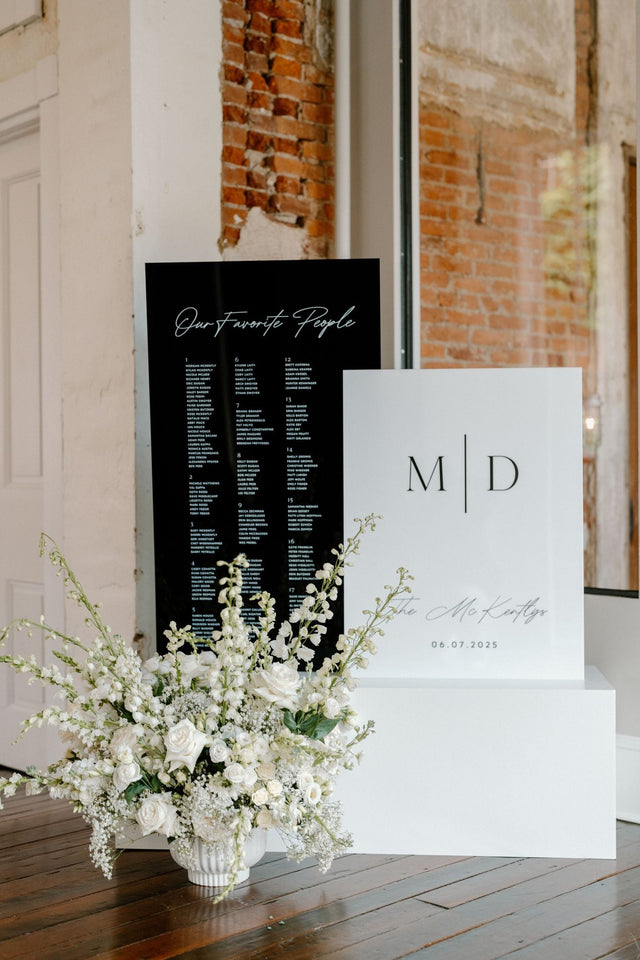
What does the seating chart sign need?
Five things, top to bottom:
- A heading, such as "Our favorite people", "Find your seat" or "We saved you a seat".
- Your names, as first names or your new last name.
- The date, and the venue or city if you'd like it.
- The list, sorted, each name with its table.
- Table numbers that match the tables. If the chart says 14, there must be a 14 on a table, in the same collection as the chart so the two read as one set.
Each chart is priced by guest count. At our live prices this week, a standard 24x30 chart runs $195 to $285 for up to 170 guests, and a large 24x36 or 24x47 chart $255 to $555 for up to 325. Linen charts run $175 to $475, and two-panel double seating charts $515 to $735. If your count isn't final, choose "Uncertain" and we invoice the difference once it is.

How do you send the list, and what if it changes?
After you order, reply to your order email with your list, typed into the email or attached as a Google Doc or Word document, about 4 weeks before the wedding. Use one of the three layouts and we set the type and the layout. Every seating chart includes a free proof: we send you a mockup of the chart to approve before it goes into production. Read it against your list, one name at a time, and send any changes before you approve it.
After the chart is printed, small changes don't need a new one. A guest who cancels can stay on the chart; ask your venue to pull the place setting. A late addition sits in one of the open seats you left, with a word to your coordinator. More on late changes in our alphabetical or by table guide.
Frequently asked questions
How far in advance should you make a wedding seating chart?
Start once most RSVPs are in, about 6 weeks before the wedding, and finish it in the following two weeks. Made & True needs the final list about 4 weeks before the wedding to make the sign.
How many guests should sit at each table?
Venue round tables usually seat 8 or 10. Divide your guest count by that number and round up: 150 guests need 19 tables of 8 or 15 tables of 10, plus the head table.
Is there a simple wedding seating chart template?
Yes. Made & True's free seating chart guide to submit is a Word document that also opens in Google Docs, with three layouts: alphabetical by last name, alphabetical by first name, or by table number. Type the names as plain lines, in the exact order you want on the sign.
Where should single guests and plus-ones sit?
Plus-ones sit next to the guest who brought them. Single guests sit with the friends they know best; a separate singles table is best avoided.
Do I need my guest list to order a seating chart sign?
No. You can order a Made & True seating chart any time and send the final list about 4 weeks before the wedding. If your guest count isn't final, choose "Uncertain" and the difference is invoiced later.
Order whenever you're ready and send the list when it's final. We'll lay out every name with you before anything is made.
Find your seating chart size
Enter your guest count and see the size and price for your list.
Try the calculator